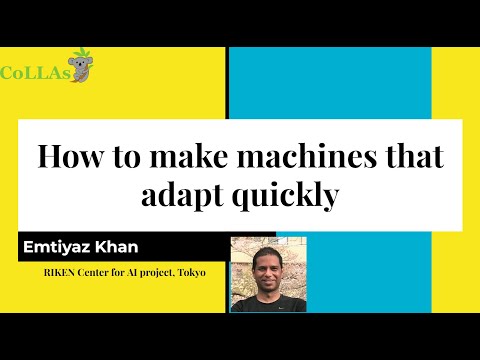
We aim to develop sustainable and transparent Artificial Intelligent (AI) systems. The goal is twofold: one, to break free from heavy dependence on extremely large data sets, computations, and energy sources, and two, to build systems with transparent functionalities. We plan to achieve these goals by developing AI systems that can learn via quick and continual adaptation, similarly to humans and animals. Our research relies on a mix of techniques from a wide variety of fields, such as deep learning, statistics, and optimization, covering both theoretical and practical tools. Please check out research and publications pages for a more exhaustive overview.
If you are interested in joining us, see the vacancies below for current opportunities and people to get to know our team.
Vacancies
Research Scientist at Polymathic AI (Location: New York):Several Research Scientist Positions in collaboration with Polymathic AI from Apr. 1st 2026. [details]
PostDoc at Polymathic AI (Location: New York):Several PostDoc Positions in collaboration with Polymathic AI from Apr. 1st 2026. [details]
Internship (Overseas Student Collaboration) Program (Location: Tokyo):Masters or PhD students from overseas, collaborative research for 3-12 months with financial support. [details]
Junior Research Associate (Location: Tokyo):Part-time positions at RIKEN for young researchers enrolled in Japanese university PhD programs. [details]
International Program Associate (Location: Tokyo):RIKEN’s joint graduate school program for non-Japanese PhD candidates at any graduate school. [details]
For all positions, send inquiries to jobs-abi [at] googlegroups.com.News
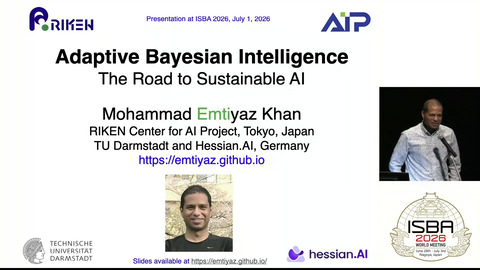
Emtiyaz Khan will give a talk at the symposium on The Future of Science at TU Darmstad.
Emtiyaz Khan will give a talk at Visual-Intelligence Workshop on Continual Learning.
The group has four papers accepted at NeurIPS 2026.
- Adrian Minut et al., SOAP-Bubbles: Structured Weight Uncertainty for Neural Networks
- Eiki Shimizu et al., Incorporating Neural Network Structure in the Bayesian Learning Rule
- Sophia Sklaviadis et al., The Bayesian Learning Rule Beyond KL Geometry
- Vatsal Venkatkrishna et al., Parameter Exploration for RLVR via Variational Learning
Congratulations to all authors!
New preprints are available:
- SOAP-Bubbles: Structured Weight Uncertainty for Neural Networks by Adrian R. Minut et al. [arxiv]
- Quantifying the Agreement Between Data-Influence and Data-Similarity to Understand LLM Behavior by Christopher J. Anders et al. [arxiv]
- Fast and Slow Variational Continual Learning by Paul Subarnaduti et al. [arxiv]